Melify.

Discover, rate, and review music

AboutBlogsTop 100 SongsSongs AI Can't MakePrivacyTermsSupportContactFeedback

© 2026 Melify

We do not sell personal information. See Privacy for details.

Melify.
A Melify series

Songs AI can't make.

A running list of songs written by grief, exile, dictatorships, and love — things a prompt can't feel.

One song per language, told through the people who lived with it — real fan voices in the original language, translated to English. Tap any song title or artist to open it on Melify and add your own rating. New entries added as the series continues.

Songs AI Can't Make Nº1 — Gracias a la Vida by Violeta Parra
SpanishChile, 1966Las Últimas Composiciones

“Gracias a la Vida”

Violeta Parra

Violeta Parra spent her life collecting Chile's folk songs village by village, then wrote the most famous one herself. “Gracias a la Vida” — “Thanks to Life” — is a hymn of gratitude: for eyes, for sound, for the alphabet, for the beloved's footsteps.

She wrote it while heartbroken, a year before she took her own life. That is the entire song: someone thanking life while it is breaking them. It became Latin America's unofficial anthem, sung at funerals, protests, and weddings alike. A model can imitate the melody in seconds. It cannot mean it.

About the song
Written by
Violeta Parra
Released
November 1966
Album
Las Últimas Composiciones
Language
Spanish
Movement
Nueva Canción Chilena
Famously covered by
Mercedes Sosa, Joan Baez

“Gracias a la Vida” (“Thanks to Life”) was written and composed by the Chilean folk singer-songwriter Violeta Parra in La Paz, Bolivia, in 1966. It opens Las Últimas Composiciones, the final album she released before her death in February 1967. The lyrics enumerate the gifts of being alive — sight, hearing, language, the beloved’s footsteps, even laughter and tears — framing them as reasons for gratitude despite suffering.

A cornerstone of the Nueva Canción Chilena movement, it became one of the most covered Latin American songs in history — carried worldwide by Mercedes Sosa (1971) and Joan Baez (1974), and later by artists from Yo-Yo Ma and Plácido Domingo to Kacey Musgraves. It was inducted into the Latin Grammy Hall of Fame in 2013.

SourcesWikipedia: Gracias a la vidaWikipedia: Las últimas composiciones
What fans say
Muchos dicen: “Si Violeta amaba tanto la vida, ¿por qué se terminó suicidando?”… Que se haya quitado la vida no le hace menos grande ni le quita sentido a su obra maestra… Personas reales, intensas como Violeta hacen falta hoy en día. El tiempo solo ha logrado inmortalizarte, Violeta. ¡¡¡Gracias Violeta!!!
Many ask: “If Violeta loved life so much, why did she end her own?”… Taking her life doesn’t make her any less great, nor does it strip meaning from her masterpiece… The world needs real, intense people like Violeta today. Time has only made you immortal, Violeta. Thank you, Violeta!!!
@lunasofian.500 · YouTube · 7.5K likes
Es mi himno y no logró imaginar a cuantos millones de seres humanos les pasa igual que a mi.
It’s my anthem, and I can’t even imagine how many millions of human beings feel exactly the same way I do.
@mariamercedescastanoramos9637 · YouTube
Songs AI Can't Make Nº2 — Construção by Chico Buarque
PortugueseBrazil, 1971

“Construção”

Chico Buarque

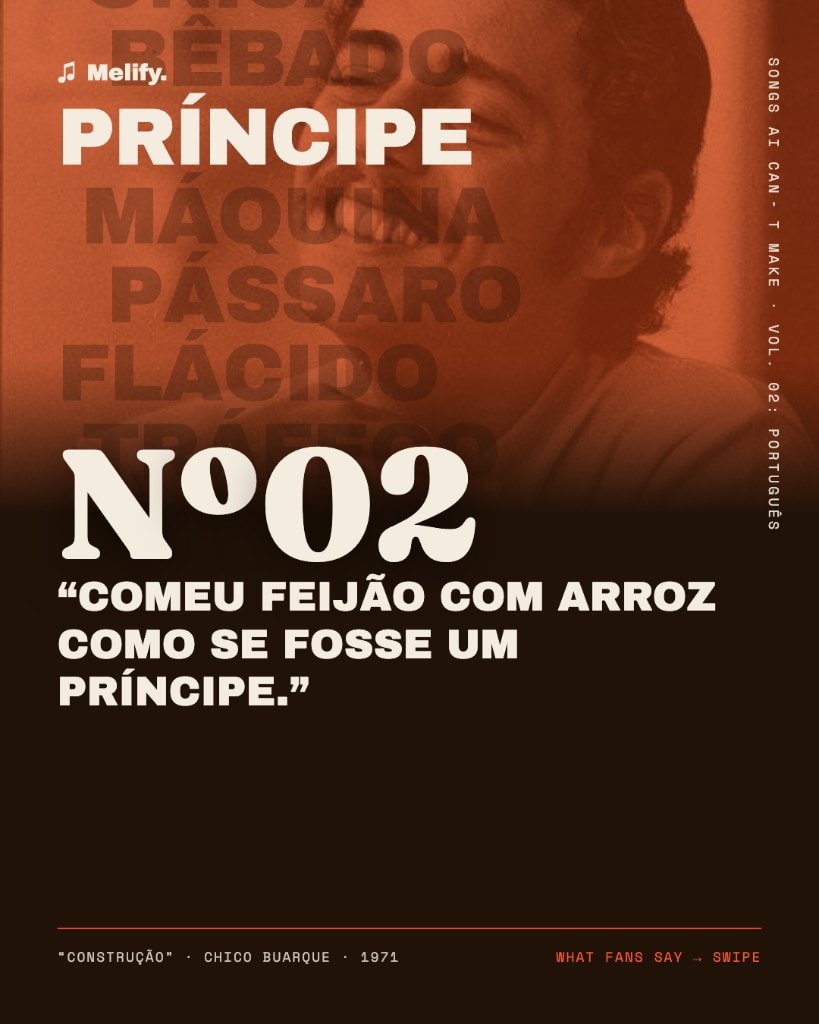
Chico Buarque wrote “Construção” in 1971, at the height of Brazil’s military dictatorship. It follows a construction worker through his last ordinary day — kissing his wife, climbing the scaffolding, eating his lunch — until he slips, falls, and dies in the street “disrupting the traffic.”

Every line ends on a proparoxytone — a word stressed on the third-to-last syllable — and the verses are rebuilt from the same words in a new order each time, so the lyric is literally constructed like the thing it describes. It is a masterpiece of Portuguese engineering and a protest smuggled past the censors. A model can rhyme proparoxytones on command. It cannot grieve an anonymous man a regime tried to erase.

About the song
Written by
Chico Buarque
Released
1971
Album
Construção
Language
Portuguese
Arrangement
Rogério Duprat
Honors
Greatest Brazilian song (Rolling Stone, 2009)

“Construção” is the title track of Chico Buarque’s eighth album, recorded for Philips Records in 1971 after his return from self-imposed exile in Italy during Brazil’s military dictatorship. Narrated in impersonal third person, it recounts the last day of a construction worker whose death is treated as a disruption to traffic rather than a human tragedy — a veiled critique of labor and social alienation under the regime.

The song is built on a strict structure: 41 dodecasyllabic lines that each end in a proparoxytone, reassembled from the same words in shifting order across three sections. The orchestral arrangement is by Rogério Duprat, a key figure of Tropicália. Rolling Stone Brasil named it the greatest Brazilian song of all time in 2009, and it featured at the 2016 Rio Olympics opening ceremony.

SourcesWikipedia: Construção (song)uDiscover Music feature
What fans say
Não dá para explicar um “Comeu feijão com arroz como se fosse um príncipe” para ninguém fora do Brasil não. Forte demais.
There’s no way to explain “he ate rice and beans as if he were a prince” to anyone outside Brazil. Too powerful.
@rodrigopassos9815 · YouTube · 3.3K likes
O texto inteiro é uma crítica à vida vazia de um trabalhador, um “zé ninguém” que ninguém se lembra. Chico mostra como uma vida pode ser, ao mesmo tempo, tão importante e tão insignificante.
The whole song is a critique of the empty life of a worker — a “nobody” no one remembers. Chico shows how a life can be, at once, so important and so insignificant.
@rodrigocampos9283 · YouTube · 821 likes
Sou brasileiro e por 25 anos ignorei a música popular brasileira… Aí ouvi este disco e ele tomou meu mundo de assalto. Se você não fala português, precisa aprender. Sim, este disco é tão bom assim.
I’m Brazilian, and for 25 years I ignored Brazilian music… Then I heard this album and it took my world by assault. If you don’t speak Portuguese, you must learn. Yes, this album is this good.
@juliano_q · RateYourMusic
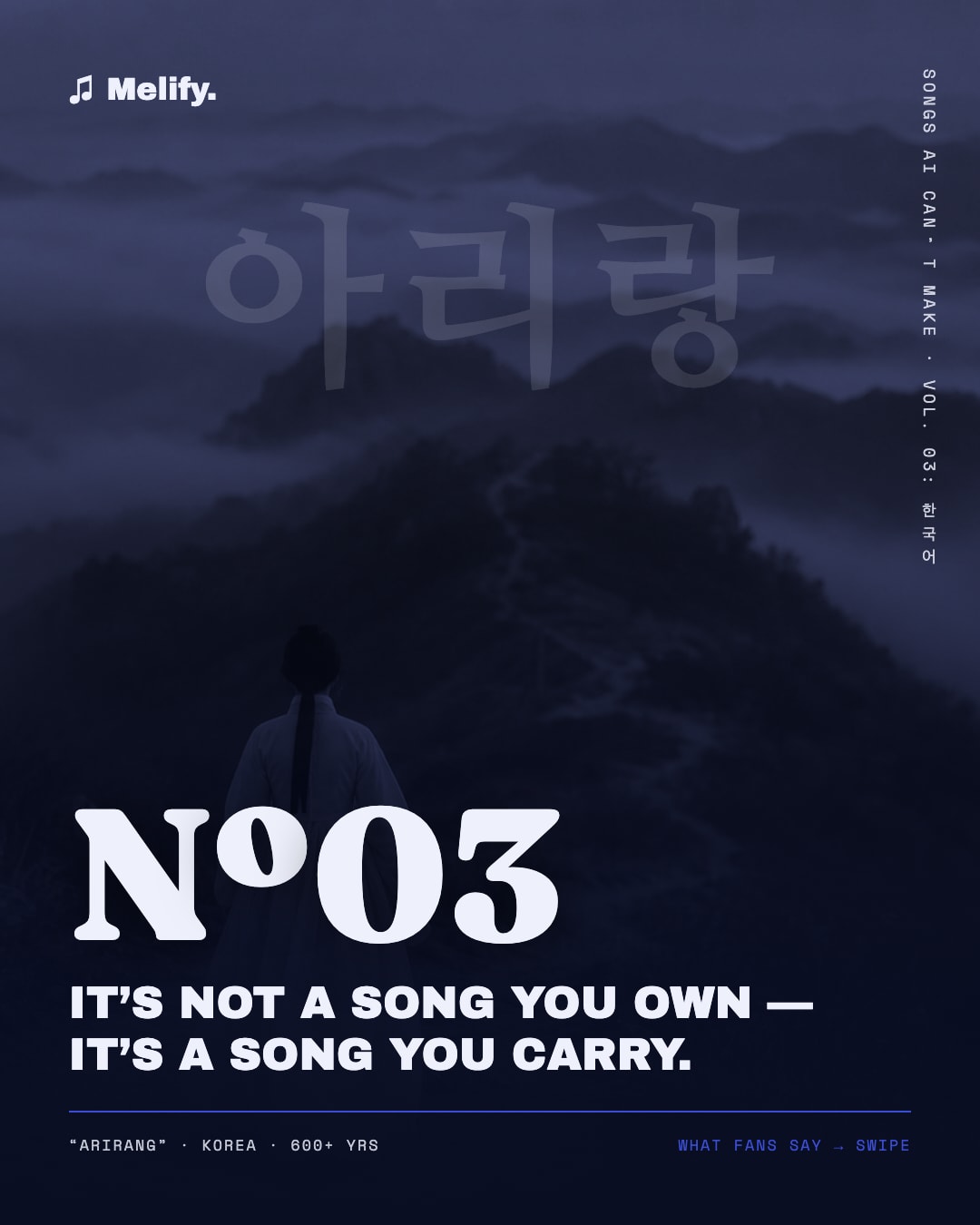
Songs AI Can't Make Nº3 — Arirang, the Korean folk song
KoreanKorea, trad.

“Arirang”

Traditional · 600+ years old

Nobody wrote “Arirang.” It is more than 600 years old, has no composer, and exists in some 3,600 regional variations — it was worn smooth by millions of ordinary Koreans across centuries until it became the country’s unofficial anthem. The word itself means nothing; the ache underneath does. Every version is about someone going over a mountain pass, leaving — maybe never to return.

It carries 한 (han) — a word with no English equivalent: sorrow, longing, and endurance in a single breath. Koreans sang it as resistance under Japanese occupation, as comfort through war, and as the song for families split by a border they never chose. A model can generate a folk melody in seconds. It cannot be authored by a whole people over six centuries, and it cannot inherit their grief.

About the song
Origin
Korea · traditional
Age
Est. 600+ years
Variations
~3,600 across 60 versions
Refrain
“Arirang, arirang, arariyo”
UNESCO
Intangible Cultural Heritage (2012 / 2014)
Also known as
Korea’s unofficial anthem

“Arirang” is Korea’s most beloved folk song. It has no single author and exists in an estimated 3,600 variations across some 60 regional versions — among them Jeongseon, Jindo and Miryang Arirang — all sharing the refrain “Arirang, arirang, arariyo.” Believed to be more than 600 years old, it is often called Korea’s unofficial national anthem because nearly every Korean, at home or abroad, can sing at least part of it.

During the Japanese occupation (1910–1945) it became an unofficial resistance anthem, sung during the 1919 March First Movement; several wartime variants were later banned for “disturbance of public order.” UNESCO inscribed “Arirang” on the Representative List of the Intangible Cultural Heritage of Humanity — submitted by South Korea in 2012 and by North Korea in 2014.

SourcesWikipedia: ArirangUNESCO ICH: Arirang
What fans say
It just touches our soul. It’s very sorrowful, and it feels like pain.
Won Hyung-joon · PRX · The World
Half of them couldn’t understand the words. They were crying anyway. You can’t teach that — and they’ll never forget it.
Younghae Kim · Inheritance
My grandfather was sent to fight and never returned. We had no bodies to bury, and it killed my parents’ souls. When I hear Arirang, I think of him.
a grandson · via Jae-Ha Kim
It’s not a word but a war.
E.J. Koh · “American Han”
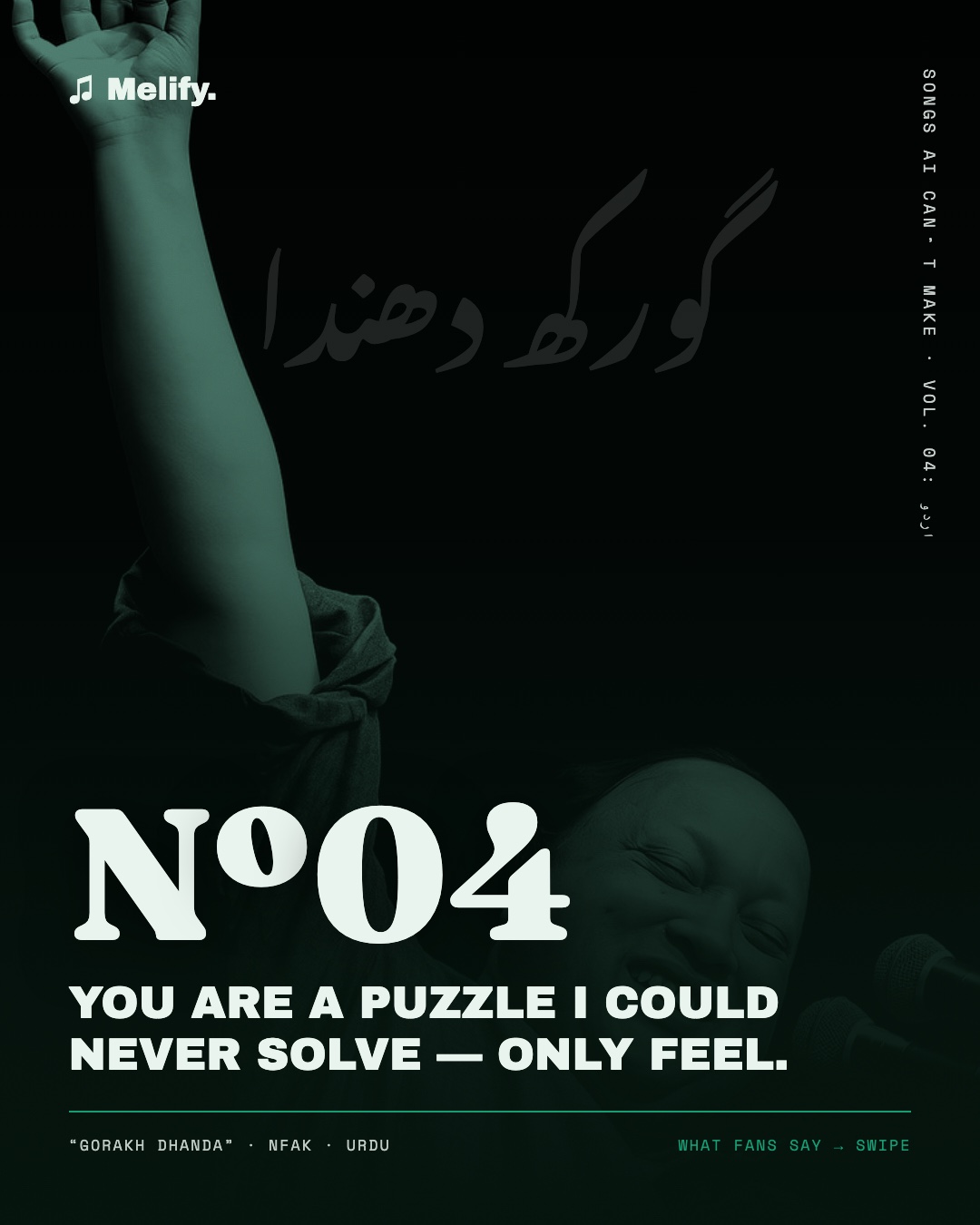
Songs AI Can't Make Nº4 — Tum Ek Gorakh Dhanda Ho by Nusrat Fateh Ali Khan
UrduPakistan, 1992Live · London, 1992

“Tum Ek Gorakh Dhanda Ho”

Nusrat Fateh Ali Khan

In December 1992, in a London hotel ballroom, Nusrat Fateh Ali Khan spent fifteen minutes arguing with God. “Tum Ek Gorakh Dhanda Ho” — “You are a tangled mystery” — sets a poem by Naz Khialvi to qawwali: the seeker looks for God in the mosque, the temple, the tavern, in logic and philosophy, and finds nothing — until he realizes God only lives in a broken heart.

Nusrat never sang it the same way twice. He improvised, folding in couplets from Ghalib and Hairat Shah Warsi on the spot, bending a single syllable into an ecstasy that made a room of strangers weep in a language most had never learned. A model can clone his timbre. It cannot doubt — and in this song the doubt is the devotion, the ache of a man who keeps believing while demanding proof. A machine has nothing to pray to.

About the song
Composed by
Nusrat Fateh Ali Khan
Poem by
Naz Khialvi
Language
Urdu
Landmark recording
London, 1992
Genre
Qawwali (Sufi devotional)
Meaning
“You are a baffling puzzle”

“Tum Ek Gorakh Dhanda Ho” is a qawwali composed and performed by Ustad Nusrat Fateh Ali Khan (1948–1997), the Pakistani “Shahenshah-e-Qawwali” (King of Kings of Qawwali), set to a philosophical Urdu poem by Naz Khialvi (1947–2010). The phrase gorakh dhanda means a baffling puzzle, or puzzle-lock; the poem is a theological complaint — kin to Iqbal’s Shikwa — wrestling with the problem of evil, free will, and a God who is everywhere yet nowhere to be found.

Its most famous rendition was recorded live on 3 December 1992 at the Intercontinental Hotel, London, during Imran Khan’s cancer-charity concert. Credited with introducing qawwali to global audiences, Khan was named one of NPR’s 50 Great Voices and ranked among Rolling Stone’s 200 Greatest Singers of All Time. Jeff Buckley called him “my Elvis,” and Peter Gabriel released his music worldwide on Real World Records.

SourcesWikipedia: Nusrat Fateh Ali KhanThe Khusrau Circle: translation & analysis
What fans say
He’s my Elvis. I idolize Nusrat — he’s a god, too.
Jeff Buckley · Interview Magazine
Nusrat is one of the greatest singers of our time. When his singing takes off, his voice embodies soulfulness and spirituality like no other.
Peter Gabriel · Real World Records
He remains an enigma, to this day. I’m still trying to understand — just how, and exactly what, was that magic?
Michael Brook · Songlines
I don’t understand a single word — and I weep every single time.
a listener · YouTube
The greatest qawwali singer of his generation.
The New York Times · on Nusrat
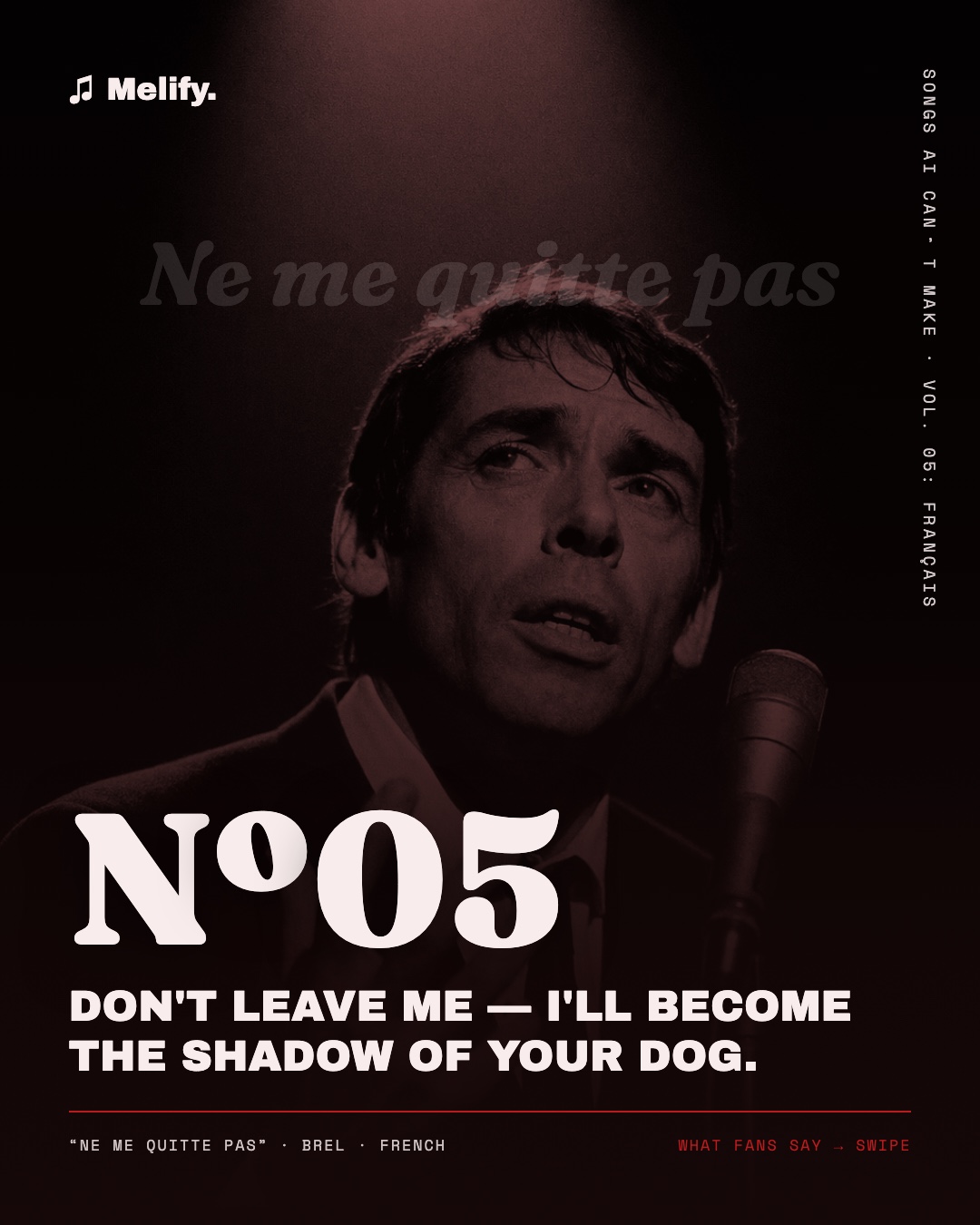
Songs AI Can't Make Nº5 — Ne me quitte pas by Jacques Brel
FrenchBelgium / France, 1959La Valse à Mille Temps

“Ne me quitte pas”

Jacques Brel

Jacques Brel wrote “Ne me quitte pas” after Suzanne Gabriello threw him out. He sat in a Montmartre bar looking at her apartment and offered, in song, to become the shadow of her dog — if that is what it took for her to stay.

In 1966 he called it not a love song but a hymn to the cowardice of men. Nina Simone covered it. Rod McKuen softened it into “If You Go Away.” The original has no soft landing. A model can generate a breakup ballad in seconds. It cannot know what it costs a man to offer to be the shadow of a dog.

About the song
Written by
Jacques Brel
Released
1959
Language
French
Genre
Chanson
Famous covers
Nina Simone, Rod McKuen
Meaning
“Don’t leave me”

“Ne me quitte pas” (“Don’t leave me”) was written and first recorded by Belgian singer-songwriter Jacques Brel in 1959. The lyric is a cascade of desperate bargains — pearls of rain from countries where it never rains, becoming the shadow of her dog — delivered without dignity, which Brel insisted was the point.

It became one of the most covered French songs in history. Nina Simone’s English-language performances and Rod McKuen’s adaptation “If You Go Away” carried it worldwide, while Brel’s own live versions — sweat, clenched fists, a voice tearing itself open — remain the definitive reading of male humiliation set to chanson.

SourcesWikipedia: Ne me quitte pasWikipedia: Jacques Brel
What fans say
It is not a love song. It is a hymn to the cowardice of men — how far they will go to humiliate themselves so they won’t be left alone.
Jacques Brel · interview, 1966
Brel’s ultimate classic. Everything else he wrote is brilliant. This one is unbearable — in the way only truth is.
a critic · on the chanson
I’ll offer you pearls of rain from countries where it never rains. That line alone has ruined more people than most entire albums.
a listener · YouTube
Sweat, clenched fists, a voice that sounds like it is tearing itself open. That is how you beg without dignity — and somehow become immortal.
a fan · Olympia
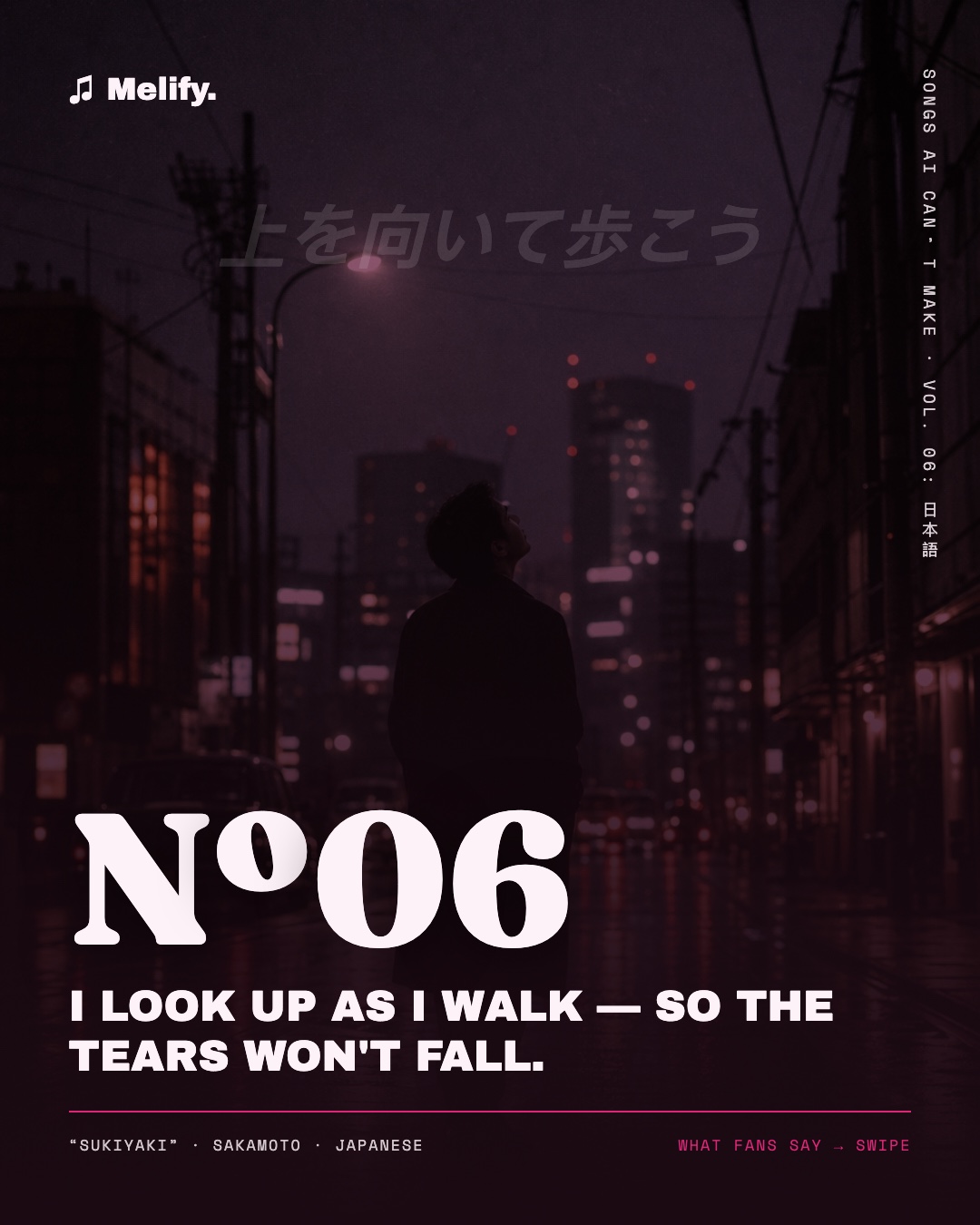
Songs AI Can't Make Nº6 — Ue o Muite Arukō (Sukiyaki) by Kyu Sakamoto
JapaneseJapan, 1961single · Toshiba

“Ue o Muite Arukō”

Kyu Sakamoto

Rokusuke Ei wrote “Ue o Muite Arukō” — “I look up as I walk” — walking home from the failed 1960 Anpo protests against the U.S.–Japan Security Treaty. The lyric is a man looking upward so his tears won’t fall. Happiness is a cloud. Loneliness is the rain he swallows.

Western executives renamed it “Sukiyaki” after a beef dish because Americans couldn’t pronounce the real title. It still hit number one on the Billboard Hot 100 in 1963 — in Japanese. America danced to a language it didn’t speak, to a grief it didn’t know was there. A model can write a sad song in seconds. It cannot know what it costs to look up so the world never sees you break.

About the song
Lyrics
Rokusuke Ei
Music
Hachidai Nakamura
Released
1961 (Japan) / 1963 (US)
Language
Japanese
US peak
Billboard Hot 100 #1
Western title
Sukiyaki (unrelated dish)

“Ue o Muite Arukō” (上を向いて歩こう, “I Look Up as I Walk”) was written by lyricist Rokusuke Ei and composer Hachidai Nakamura, and recorded by Kyu Sakamoto in 1961. Ei drafted the lyric after the Anpo protests; the words were kept purposely generic so they might also read as lost love.

Released in the West as “Sukiyaki,” it became the first Asian-language song to top the Billboard Hot 100, selling over 13 million copies worldwide. The cheerful melody and Sakamoto’s gentle delivery masked a private grief that Japanese listeners always heard clearly — and that Western audiences often mistook for a novelty hit about dinner.

SourcesWikipedia: Sukiyaki (song)PBS: Songs of the Summer 1963
What fans say
Rokusuke Ei wrote it walking home from the failed 1960 Anpo protests. A political heartbreak disguised as a love song — so it could survive anywhere.
a historian · on the Anpo protests
They renamed it Sukiyaki — after a beef dish — because Americans couldn’t pronounce the real title. The saddest song in Japanese became a novelty hit about dinner.
a critic · on Capitol Records
My grandmother hummed this without knowing a word of Japanese. She said it sounded like someone being brave. She was right.
a listener · YouTube
The melody sounds like hope. The lyrics are a man refusing to let anyone see him cry. That gap is the whole song.
a fan · essay
Songs AI Can't Make Nº7 — Mera Joota Hai Japani by Mukesh / Raj Kapoor
HindiIndia, 1955Shree 420

“Mera Joota Hai Japani”

Mukesh / Raj Kapoor

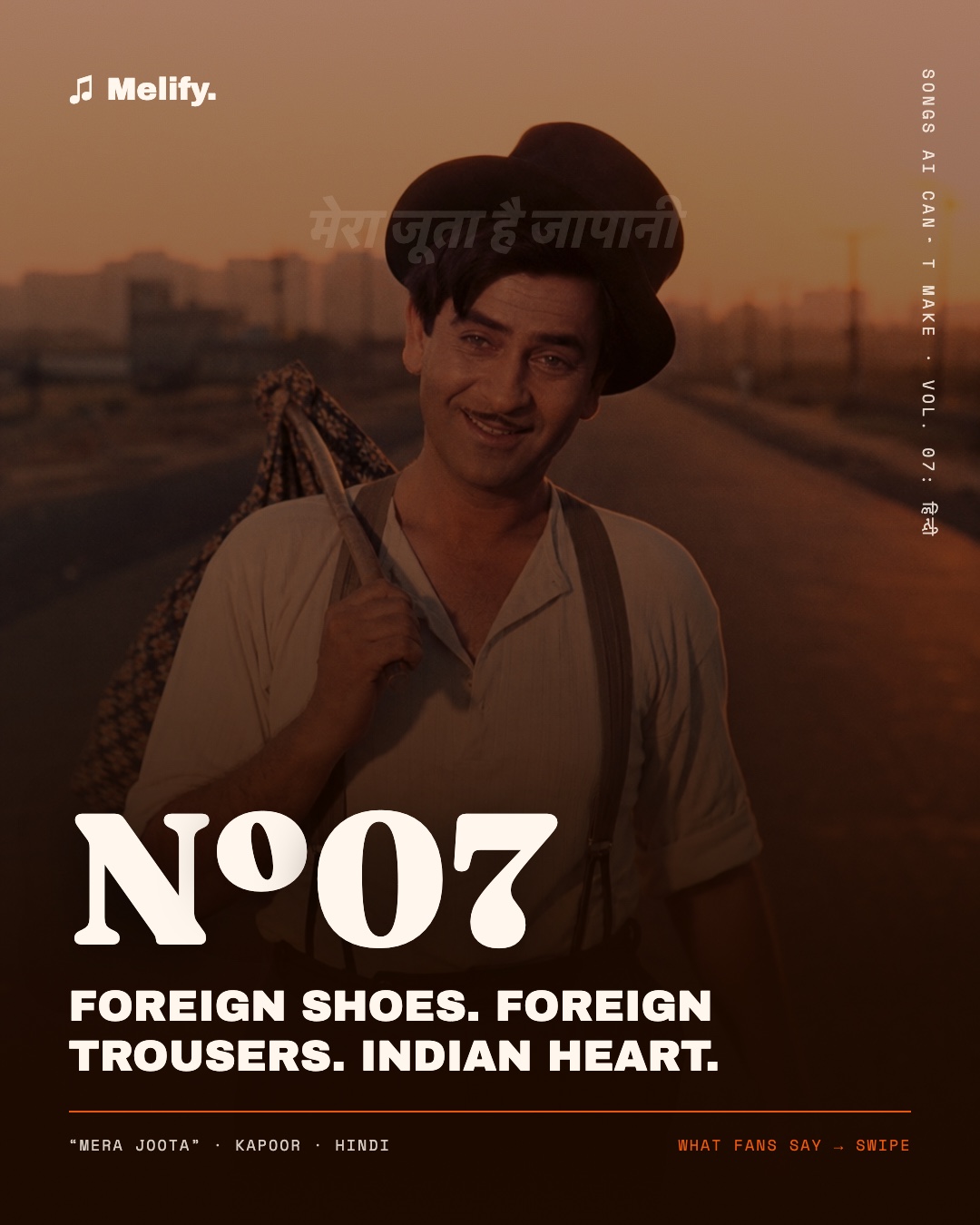
In Shree 420 (1955), Raj Kapoor’s tramp walks an open road singing Shailendra’s lyric: Japanese shoes, English trousers, a red Russian cap — and still, an Indian heart. Mukesh’s voice made it sound like a child could hum it and a nation could claim it.

This is Nehru’s India in four lines: open to the world, unashamed of foreign cloth, certain the heart stays home. Salman Rushdie opened The Satanic Verses with it. A model can generate a patriotic anthem. It cannot know what it means to wear the world’s clothes and still refuse to sell your heart.

About the song
Lyrics
Shailendra
Music
Shankar–Jaikishan
Singer
Mukesh
Film
Shree 420 (1955)
Language
Hindi
Meaning
“My shoes are Japanese”

“Mera Joota Hai Japani” (“My Shoes Are Japanese”) was composed by Shankar–Jaikishan with lyrics by Shailendra for Raj Kapoor’s 1955 film Shree 420, sung by playback legend Mukesh. The chorus asserts Indian identity while cheerfully listing foreign clothes — a cosmopolitan patriotism that matched the early republic’s internationalist mood.

It became one of Hindi cinema’s most enduring anthems: hummed across generations, cited in literature and politics, and still shorthand for a heart that travels without leaving home. Kapoor’s Chaplin-inspired tramp made the philosophy walkable — comedy on the surface, a constitution underneath.

SourcesWikipedia: Mera Joota Hai JapaniWikipedia: Shree 420
What fans say
This is Nehru’s India in four lines: open to the world, unashamed of foreign cloth — and certain that the heart stays home.
a critic · on post-independence India
Raj Kapoor borrowed Chaplin’s tramp and gave him an Indian heart. The walk is comedy. The song is a constitution.
a fan · essay
Mukesh sang it so simply a child could hum it — and so truly a nation claimed it.
a listener · YouTube
Most patriotic songs shout. This one grins, tips its hat, and keeps walking. That is why it never gets old.
a fan · tribute
Songs AI Can't Make Nº8 — Al-Atlal by Umm Kulthum
ArabicEgypt, 1966live premiere · Cinema Qasr el-Nil

“Al-Atlal”

Umm Kulthum

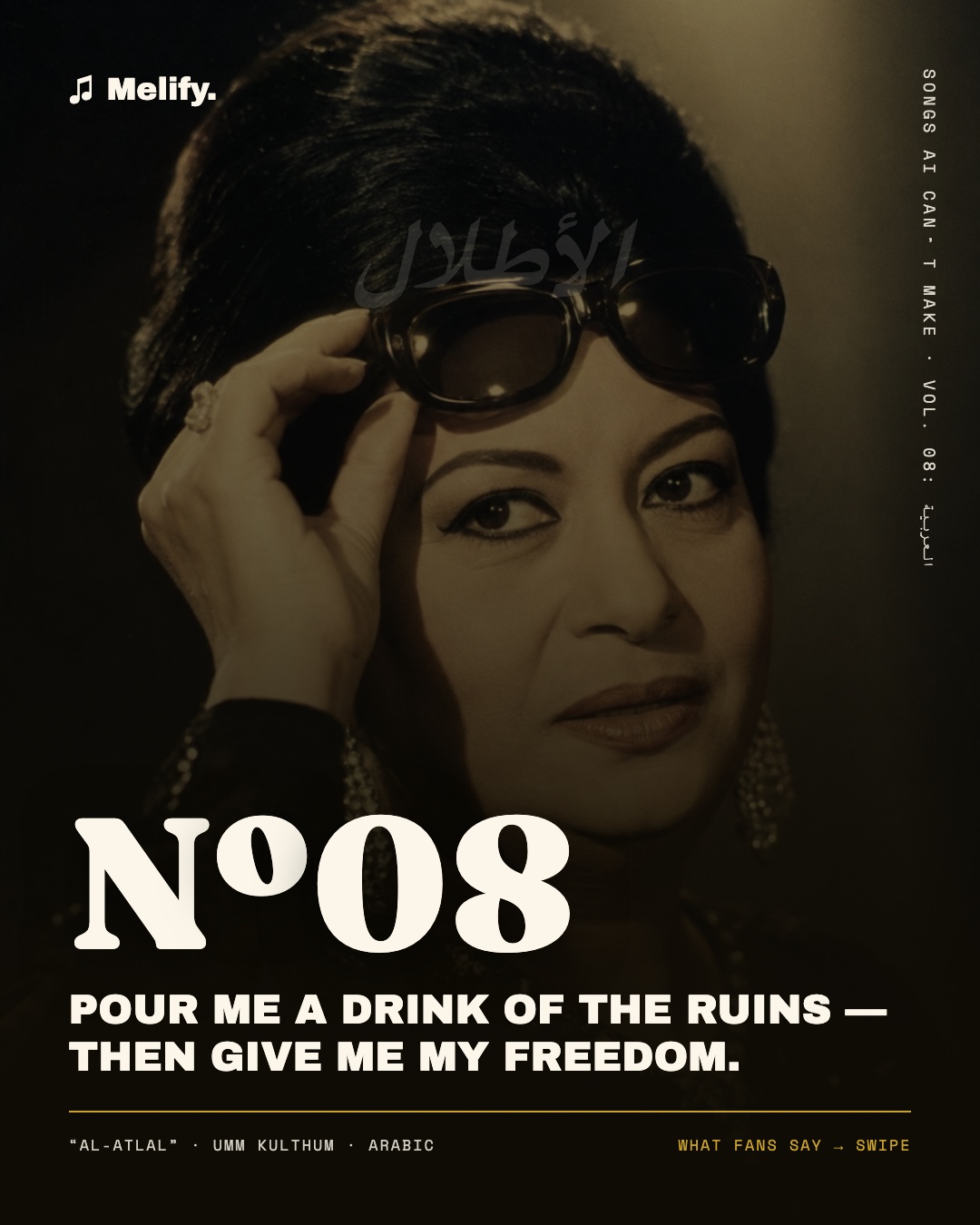
Umm Kulthum premiered “Al-Atlal” — “The Ruins” — at Cinema Qasr el-Nil on 7 April 1966. The lyric came from Ibrahim Nagi’s poems: a heart standing amid the collapsed citadel of love, asking for a drink of the ruins, then demanding freedom from bloodied chains.

Nagi died thirteen years earlier and never heard it. Riad Al Sunbati built a cathedral of melody around those ruins; Umm Kulthum walked into it and made every stone sing. A model can generate heartbreak in any language. It cannot stand in the ruins of a love and demand freedom with a voice that makes a continent weep.

About the song
Poem by
Ibrahim Nagi
Music
Riad Al Sunbati
Premiered
7 April 1966
Language
Arabic
Genre
Tarab / classical Arabic song
Meaning
“The Ruins”

“Al-Atlal” (الأطلال, “The Ruins”) adapts poetry by Egyptian physician-poet Ibrahim Nagi (primarily from Al-Atlal and Al-Wadaa), composed by Riad Al Sunbati and performed by Umm Kulthum. The word atlal reaches back to pre-Islamic Arabic poetry — the poet standing at abandoned campsite ruins remembering a lost beloved.

Premiered in 1966 after years of preparation, it is widely regarded as a summit of twentieth-century Arabic song: tarab at full scale, where a single performance could last as long as grief required. Lines like “Give me my freedom, release my hands” turned private heartbreak into a public declaration that still stops rooms across the Arab world.

SourcesWikipedia: Al-AtlalThe National: on atlal
What fans say
My heart, don’t ask where the love has gone. It was a citadel of my imagination that has collapsed. Pour me a drink — and let us drink of its ruins.
Ibrahim Nagi · Al-Atlal
Give me my freedom. Release my hands. Your chains have bloodied my wrists. That is not a love song ending. That is a declaration.
a listener · on the lyric
When she sang Al-Atlal, the East stopped — and listened to a woman standing in the ruins of love without flinching.
a critic · tribute
Some songs last three minutes. Al-Atlal lasts as long as grief needs — and Umm Kulthum never rushed a single syllable of it.
a fan · concert memory

Every song here can be rated and reviewed on Melify.

Add your own voice — in any language. That's the part AI really can't do.

Find musicTop 100 songs
TRENDINGMovin' To The Sun by HUGEL, Imael Angel, Ultra Naté/TRENDINGLoser by Tame Impala/TRENDINGJamaican (Bam Bam) by HUGEL & SOLTO (FR)/TRENDINGoh yeah? by Steve Lacy/TRENDINGSelf Aware by Temper City/TRENDINGDai Dai by Shakira, Burna Boy/TRENDINGFREAKED OUT by Fat Papi, prodshushy/TRENDINGBeni Al (Ta Ki Seni Görene Kadar) [Remix] by Meltem Hayirli & Ankara Echoes/SEARCHEDPedro Henrique/SEARCHEDAngel y Khriz/SEARCHEDThe Strokes/SEARCHEDCongolese musicians/SPOTIFYSave My Love by Kygo, Khalid, Gryffin/SPOTIFYFortnight (feat. Post Malone) by Taylor Swift, Post Malone/TRENDINGMovin' To The Sun by HUGEL, Imael Angel, Ultra Naté/TRENDINGLoser by Tame Impala/TRENDINGJamaican (Bam Bam) by HUGEL & SOLTO (FR)/TRENDINGoh yeah? by Steve Lacy/TRENDINGSelf Aware by Temper City/TRENDINGDai Dai by Shakira, Burna Boy/TRENDINGFREAKED OUT by Fat Papi, prodshushy/TRENDINGBeni Al (Ta Ki Seni Görene Kadar) [Remix] by Meltem Hayirli & Ankara Echoes/SEARCHEDPedro Henrique/SEARCHEDAngel y Khriz/SEARCHEDThe Strokes/SEARCHEDCongolese musicians/SPOTIFYSave My Love by Kygo, Khalid, Gryffin/SPOTIFYFortnight (feat. Post Malone) by Taylor Swift, Post Malone/TRENDINGMovin' To The Sun by HUGEL, Imael Angel, Ultra Naté/TRENDINGLoser by Tame Impala/TRENDINGJamaican (Bam Bam) by HUGEL & SOLTO (FR)/TRENDINGoh yeah? by Steve Lacy/TRENDINGSelf Aware by Temper City/TRENDINGDai Dai by Shakira, Burna Boy/TRENDINGFREAKED OUT by Fat Papi, prodshushy/TRENDINGBeni Al (Ta Ki Seni Görene Kadar) [Remix] by Meltem Hayirli & Ankara Echoes/SEARCHEDPedro Henrique/SEARCHEDAngel y Khriz/SEARCHEDThe Strokes/SEARCHEDCongolese musicians/SPOTIFYSave My Love by Kygo, Khalid, Gryffin/SPOTIFYFortnight (feat. Post Malone) by Taylor Swift, Post Malone/